Showing posts with label Barack Obama. Show all posts

Friday, January 23, 2009

Commander-in-Chief Obama

Just saw an interesting story on President Obama's upcoming meeting with military commanders at the Pentagon.

From the AP:
Iraq is stable enough to allow the roughly 22,000 U.S. Marines there to withdraw, the service's top general said Friday.

"The time is right for Marines in general terms to leave Iraq," said Marine Corps Commandant James Conway.

The Marine Corps can't fight in both Iraq and Afghanistan, he said, because it does not have enough combat support troops and equipment to divide between the missions.

"Anything that you put into Afghanistan must necessarily come as a reduction of Marine forces in Iraq," he told reporters. "When the door slams on the Marines in Iraq, let all the Marines be on the other side of the door."

Conway has been pushing for a large deployment of Marines to Afghanistan for months. No decisions have been made on the size of the force that would be sent.

More interestingly, was this observation:

Conway said that Obama's willingness to meet with his military chiefs at the Pentagon instead of the White House amounts to a gesture of respect to the commanders.

"It is great symbology; he's on our turf," he said. "More importantly, he gets to meet and shake hands with hundreds of people in all the services."

President Obama continually impresses me with his collaborative nature, political maturity, and his respectful demeanor.

Sphere: Related Content

Closing Gitmo ~ Restoring America's honor

Obama signed the Executive Order to close Guantanamo Bay Prison within one year.


Already the Conservatives pundits are going crazy with fear. What I find astonishing is that they think that Gitmo has kept Americans safe; when in reality, this very act was probably Al Qaeda's most powerful recruiting tool! They can advertise how unjust and hypocritical the United States is, and they would laugh and spit on our notion of Democracy.

According to the latest Gallup Poll, 45% of Americans do not believe that Guantanamo Bay should be closed. This was quite surprising and shocking to me. How can more Americans not see how morally wrong it is to torture. Can anyone,who professes to be a Christian, even say with a clear conscious that torture is acceptable?? How can Americans who profess that we feel so strongly about democracy and freedom, that we are willing to die for it, suddenly become so cowardly to say, we need to ignore human rights and that torture is acceptable because it will keep us safe.

As a society that upholds democratic ideals and principles, everyone should know that torture is wrong. You don't need a law to tell you that to commit such barbaric acts is not right. If that was the case, then why not castrate rapists and pedophiles? Yet we don't do this, because that is an act that is not reflective of a humane and just society. This idea that we can even attempt to tell the rest of the world, China included, to respect Human Rights, and push them toward a democractic model, while continually supporting torture and rendition, and ignoring Habeus Corpus is laughable.

The Habeas Corpus act of 1649 and its interpretation was clearly upheld and incorporated into our Constitution by the Founding Fathers. Furthermore, the Founding Fathers, when developing the Constitution, clearly put the focus and emphasis on individual freedoms, and checks and balances against the limitations of Government abuses. This is why during criminal trials, the burden of proof rests with the State, not the individual. This is why illegal search and seizures are not allowed.

George Bush created a nightmare when he created Guantanamo Bay Prison. He was on record for trying to close it, however, he was unable to accomplish it, simply due to the legal complexities, and the fact that because evidence obtained by torture taints the evidence.


I have no doubt that there are some very dangerous terrorists, at the same time, there is also a large probability that a majority are innocent people who have been illegally imprisoned. They have had no avenues for justice, nor have they been able to petition for release due to lack of evidence. However, by imprisoning and torturing them unjustly, we have now just made more enemies.

Let's remember that all the former Secretary of States went on record on the CNN Forum "The Next President: A World of Challenges":

AMANPOUR: General Powell, it's not just about like, is it? It's about being able to get things done. America is the strongest nation in the world. But a new intelligence report is going to tell the next president that America's dominance is not going to be as supreme as it was.

So what do you tell the next president about how to regain respect?

POWELL: I think we have to recognize that there are other nations in the world now whose economic strength is growing, and therefore their political influence is growing.

I don't know that we should be afraid of this or see that as a threat to us. Isn't this what we were working for all of these many decades? We wanted them to rise up and join the international economic community. And that is what is happening.

We're working multilaterally to solve the Iranian problem, the North Korean problem. We have worked with the world to increase funding for HIV-AIDS. We've doubled the amount of money we're putting into development assistance around the world.

So I think a case can be made that we can build on that strength. And the new president, with a different approach to things, and with a different attitude to the rest of the world, can reverse this.

SESNO: But how about some tangible things that the next administration, the next president can do to change policy or send a signal that will address these issues?

POWELL: Close Guantanamo.

ALBRIGHT: Close Guantanamo. I think...

BAKER: Close Guantanamo. We were on a panel together several months ago, and we all agreed, one of the best things that could happen would be to close Guantanamo, which is a very serious blot upon our reputation.
Military experts all agree that torture is not a reliable method for obtaining evidence. Unfortunately, most Americans watch too much TV, and have been fooled by the television "24", and the notion that by torturing someone, it will for sure get that critical piece of intelligence that will help defuse a bomb with 1 minute to spare!
Sphere: Related Content

Tuesday, January 20, 2009

Inauguration of Barack Obama ~ 44th President of the United States


For as much as government can do and must do, it is ultimately the faith and determination of the American people upon which this nation relies. It is the kindness to take in a stranger when the levees break, the selflessness of workers who would rather cut their hours than see a friend lose their job which sees us through our darkest hours. It is the firefighter's courage to storm a stairway filled with smoke, but also a parent's willingness to nurture a child, that finally decides our fate.

Our challenges may be new. The instruments with which we meet them may be new. But those values upon which our success depends - hard work and honesty, courage and fair play, tolerance and curiosity, loyalty and patriotism - these things are old. These things are true. They have been the quiet force of progress throughout our history. What is demanded then is a return to these truths. What is required of us now is a new era of responsibility - a recognition, on the part of every American, that we have duties to ourselves, our nation, and the world, duties that we do not grudgingly accept but rather seize gladly, firm in the knowledge that there is nothing so satisfying to the spirit, so defining of our character, than giving our all to a difficult task.

This is the price and the promise of citizenship.

This is the source of our confidence - the knowledge that God calls on us to shape an uncertain destiny.

The Inauguration of Barack Obama was filled with amazing pomp and circumstance, tradition, electricity, history, joy, relief, and somberness. His Inauguration speech embodied the commitment to our ideals as brought forth by our founding fathers, the renewal, individual responsibility, engagement, and collaboration that will be required to meet the challenges of the future. It was everything that we needed to inspire us on this special day.


Sphere: Related Content

President-Elect Barack Obama

The day is finally here ~ a day that is celebrated within the US, and around the world. What I find constantly amazing is the massive interest from people in the International Community in President-elect Barack Obama (it will be a wonderful thing to drop the "elect").

While some may say the end of American Exceptionalism is at hand, I am not entirely too sure. I think the end of American Exceptionalism as it relates to an "anything goes because we are Americans" or rogue cowboy style of leadership is certainly at an end. However, I still believe that what sets the US apart from any other nation is that we were created from a set of ideals, and not necessarily any one homogenous ethnic group. The fact is, the US culture, Constitution and history is unique and sets us apart from any other country.

President-elect Obama's inauguration represents a possibility that truly has not been a possibility in any other nation. I especially consider a homogenous country like South Korea or even France. As much as the French tout their Liberte and Egalite, they are still driven by nationalistic prejudice of all things French - even their politicians.

So I think back on election night, and the electrifying emotions that I felt on hearing that Barack Obama had become the new President-Elect of the United States, and it instills again an overflowing pride in my country and what we represent apart from any other country.

Sphere: Related Content

Monday, January 19, 2009

It's a New Day

Will.i.am has a great song and video to celebrate the election of Barack Obama as our 44th President - "It's a New Day". It's infectious in it's optimism and hope, that you can't help but dance with joy.

Sphere: Related Content

Saturday, January 17, 2009

Train to the Inauguration

Well Obama has kicked-off his Inauguration with the historic train ride from Philadelphia to Washington DC.

His speech in the 30th Street Train Station was filled with promise, grace, and encouragement. It again reminds me what a once in a lifetime President we have before us. It is not to say that we can expect Barack Obama to fix all the deep and troubling problems we have before us, but his leadership, intelligence, and his ability to connect with the American people demonstrates what a truly remarkable and promising President he will be - not just the US, but in the international community.

And yet while our problems may be new, what is required to overcome them is not. What is required is the same perseverance and idealism that our founders displayed. What is required is a new declaration of independence, not just in our nation, but in our own lives - from ideology and small thinking, prejudice and bigotry - an appeal not to our easy instincts but to our better angels.

That is the reason I launched my campaign for the presidency nearly two years ago. I did so in the belief that the most fundamental American ideal, that a better life is in store for all those willing to work for it, was slipping out of reach. That Washington was serving the interests of the few, not the many. And that our politics had grown too small for the scale of the challenges we faced.

But I also believed something else. I believed that our future is our choice, and that if we could just recognize ourselves in one another and bring everyone together - Democrats, Republicans, and Independents, north, south, east and west, black, white, Latino, Asian, and Native American, gay and straight, disabled and not - then not only would we restore hope and opportunity in places that yearned for both, but maybe, just maybe, we might perfect our union in the process.


Sphere: Related Content

Friday, January 16, 2009

The Bush Legacy

Tonight on Countdown, Keith Olbermann reported on Bush's last 8 years in 8 minutes, and even though it's widely accepted that Bush has been a terrible President, I was still shocked to realize just how much has been lost, destroyed, and eliminated during his presidency.


It's difficult to see how anyone can say that History will judge Bush kindly, given that the choices and decisions that George W. Bush has undertaken has seriously undermined the stability and security of our country.

So as I write my 100th blog post, I am finally happy to say good-bye to George W. Bush, and I eagerly await the inauguration of a calm, thoughtful, commanding, intelligent, just, rational, and compassionate President.
Here is one last comparison between the different styles of the two Presidents:
Sphere: Related Content

Sunday, January 11, 2009

Why won't "Trickle Down" Economics Die?

I was watching "Meet the Press" this morning, and the first topic of the show was, of course, about the economy and Obama's stimulus package. David Gregory had a round table discussion with former Congressman David Bonior of Michigan; editorial page editor of The Wall Street Journal, Paul Gigot; chief Washington correspondent for CNBC and New York Times political writer John Harwood; Vanity Fair contributing editor Bethany McLean; and chief economist of Moody's economy.com Mark Zandi.

It was clear that Obama is already on the offensive, marketing his plan, and getting the public acclimated to this stimulus plan. The show didn't offer anything new in terms of analysis. The entire discussion can be summed up as follows:

1. We need to do this, otherwise the economy will be in bigger trouble
2. We need to do something, but we should do something else, like tax cuts
3. How will we pay for this ~ followed by requisite ringing of hands

MR. GREGORY: And what about--Paul, what about the idea of tax cuts as being as stimulative as infrastructure spending?
MR. GIGOT: Well, I think they're much more stimulative if they're the right tax cuts.
MR. GREGORY: Mm-hmm.
MR. GIGOT: I mean, we have a capital strike going on right now. Nobody wants to take any risks, nobody wants to make any investments. Part of it's the uncertainty about the damage that Congress might do, but part of it is also the fact that everybody's frozen. You need the incentives to invest, particularly in the private sector.
MR. GREGORY: Right.
MR. GIGOT: I think a, a tax cut, a big corporate rate tax cut, for example, or an across the board tax cut would be a lot more stimulative than this public spending, which has to come from somewhere.

At what point will Conservatives wake up and smell the coffee - "Trickle Down" Economics is DEAD. The last 20 years of deficit spending and tax cuts under Republican Presidents do nothing but hamper the Government's ability to intervene in Economic downturns, and in fact do more to harm to the economy, causing false bubbles, uncontrollable greed, and recessions.

There continues to be this debate on what spurs the economy. It's a basic fundamental principle that the economy grows as a result of consumption and spending. Capital investments facilitate growth, but capital investments are worthless, if there is no growth or profit to be had.

We need to recognize that the key to growing the economy, is growing DEMAND. Demand for goods and services will continue to exist and grow, as long as people have real income keeping pace. Once Income falls or declines, so does the DEMAND, hence production also slows, continuing a spiral contracting of the economy.

So I don't care how much of a tax cut incentive the government gives, unless there is demand and organic market growth potential for the business, there won't be a need for that capital.

Tax cuts have one small benefit, in that they provide instant relief, and add income for consumption. However, most economists recognize that the dollar return on investments for tax cuts are less than the cost of the tax cuts themselves. It's also clear that Obama will need some tax cuts, to gain Republican support for his plan.

MR. GREGORY: Mark Zandi, as an economist, what's your big question about it?
MR. MARK ZANDI: Is it big enough? Is $750 billion, a trillion dollars enough? The economy is in great trouble. We lost 500,000 jobs in December, 2.6 million jobs in 2008. That's the most since 1945.
MR. GREGORY: Mm-hmm.
MR. ZANDI: Unemployment's 7.2 percent. So is 750 billion, a trillion going to be enough to jump-start the economy, to get the private sector back in the game?

MR. GREGORY: The issue of impact, Mark Zandi, speaks to some of the risk of how long it takes. This is how The New York Times reported it Saturday: "The risk is that Obama and the Congress will weigh down their effort with measures that cost many billions of dollars but may not have much impact on economic activity. Tax breaks, for example, usually produce less than $1" worth "of stimulus for every dollar they cost, economists say. Spending on public construction projects, like highways and bridges, produces the most economic activity--but there's a limit to how many projects are `shovel-ready,' and even those take time to generate jobs and ripple through the economy."

MR. ZANDI: But we, but we have no choice. We really don't. I mean, if we don't do something like this, a stimulus package, a foreclosure mitigation plan, the economy is going to slide away. Unemployment is going to rise into the double digits and we're going to lose tax revenues as a result and the deficit's going to be even larger than otherwise.
MR. GIGOT: But, Mark, don't you think that monetary policy is very powerful here? I mean, Christina Romer, who's the president's economic adviser now, she has written in 1994 that fiscal actions have relatively small effects. The big bang for the buck is monetary policy.
MR. ZANDI: In normal times I would agree with you, Paul, but this--the link between the Fed and the economy runs through the financial system. The financial system is literally broken. There--if--you can provide as much cash as you want; but you don't get credit, you don't get it done.

MR. GIGOT: I mean, if you're borrowing it for aircraft carriers like Reagan did to win the Cold War, you get a big payoff down the road. If you're doing it for tax cuts that really stimulate and drive private investment, and in two or three years' time bring the economy back, great. But if it goes to pork, if it goes to green jobs that may sound good in the short term but may not have a market response or a market for them, then it's a waste.


What still gets me is the ridiculous Republican Talking points that Paul Gigot continues to expound, that Monetary Policy is the answer, and that Tax Cuts (to the wealthy and Corporations) are more effective than any fiscal policy. The real gem was the Paul's glowing and inaccurate description of the benefits of Reagonomics. The fact that the WSJ editorial board seems to only regurgitate Republican ideas and principles, renders the paper virtually worthless, except as a birdcage liner.

Overall, my opinion is that I think Obama has shown his political savviness, in the fact that he already recognizes that most economists believe that the stimulus plan will have to be much bigger, hence it's much easier to start with something smaller and let it grow, as opposed to put something too big on the table that will have Republicans balking. What's ironic, is that after 8 years of deficit spending under a Republican President and a Republican controlled Congress, we suddenly have Republicans growing a conscious about the size of the deficit.
Sphere: Related Content

Obama in touch with the Public

It's well known that Obama is fighting to keep his Blackberry, as he sees it as important for him to keep in touch with average Americans, and he continues to make efforts to openly interact with the public, whether it's getting ideas and questions via the transition website Change.gov or just dropping by a local Washington landmark, Ben's Chili Bowl.

That would be a half-smoke, actually, and an iced tea, and the institution was a longtime U Street establishment, Ben’s Chili Bowl, where a visit from the Obama family has been anticipated.

Well, Mr. Obama didn’t bring the whole family this time, but he was accompanied to the diner, which has been in business 50 years, by Mayor Adrian Fenty of Washington, an ally of his.

In a departure from his healthy diet, Mr. Obama ordered a classic Ben’s half-smoke — a pork and beef sausage on a steamed hot dog bun, topped with mustard, onions and chili sauce — and a sweetened iced tea. Mr. Fenty chose the turkey dog, cheese fries and bottled water. The bill came to $19.15 with taxes, according to prices from Ben’s menu.

Mr. Obama looked over at Mr. Fenty’s lunch and asked the server, Jermaine Jefferson, “Where’s my cheese?”

Immediately after the election, Ben’s co-owner, Nizam Ali, told The Times that he had invited the Obamas to drop in and eat for free, an offer made to help the new First Family feel at home in Washington. The President-elect took up the offer to drop in for a bite, but declined the offer to eat on the house; he paid for his and the mayor’s food with a $20 bill and told the cashier to keep the change.

Sphere: Related Content

Thursday, January 8, 2009

Who will buy US Debt?

Today, Obama announced his economic Stimulus plan "American Recovery and Reinvestment," the name of his proposed $750 billion stimulus package at George Mason University.
"Throughout America’s history, there have been some years that simply rolled into the next without much notice or fanfare. Then there are the years that come along once in a generation – the kind that mark a clean break from a troubled past, and set a new course for our nation. This is one of those years. We start 2009 in the midst of a crisis unlike any we have seen in our lifetime – a crisis that has only deepened over the last few weeks. Nearly two million jobs have now been lost, and on Friday we are likely to learn that we lost more jobs last year than at any time since World War II. Just in the past year, another 2.8 million Americans who want and need full-time work have had to settle for part-time jobs. Manufacturing has hit a twenty-eight year low. Many businesses cannot borrow or make payroll. Many families cannot pay their bills or their mortgage. Many workers are watching their life savings disappear. And many, many Americans are both anxious and uncertain of what the future will hold.

I don’t believe it’s too late to change course, but it will be if we don’t take dramatic action as soon as possible. If nothing is done, this recession could linger for years. The unemployment rate could reach double digits. Our economy could fall $1 trillion short of its full capacity, which translates into more than $12,000 in lost income for a family of four. We could lose a generation of potential and promise, as more young Americans are forced to forgo dreams of college or the chance to train for the jobs of the future. And our nation could lose the competitive edge that has served as a foundation for our strength and standing in the world. In short, a bad situation could become dramatically worse...."

What's interesting is that earlier this week, the International Herald Tribune reported that China is losing it's taste for US Debt.
China has bought more than $1 trillion in American debt, but as the global downturn has intensified, Beijing is starting to keep more of its money at home - a shift that could pose some challenges to the U.S. government in the near future but eventually may even produce salutary effects on the world economy.

But now, Beijing is seeking to pay for its own $600 billion economic stimulus - just as tax revenue falls sharply as the Chinese economy slows. Regulators have ordered banks to lend more money to small and midsize enterprises, many of which are struggling with slower exports, and Chinese bankers say they are being instructed to lend more to local governments to allow them to build new roads and other projects as part of the stimulus program.

Given the ambitious stimulus plan that Obama has in mind, it will be interesting to see how the Treasury will raise the capital, with demand decreasing for US Debt. In addition, what will be the effect of rising interest rates on capital investments for the private sector and for consumers?
Sphere: Related Content

Tuesday, January 6, 2009

Transitions

Happy New Year to All!

Aside from having to remember to write 2009 and not 2008 on checks, to me, it's just another day in the continuing march of time. While some may think of the New Year as a chance to change habits, lose weight, learn new things, or wiping the slate clean; I personally do not make New Years Resolution. I don't see the point for why we have to have a special day to make commitments? Why put it off tomorrow, why can't people just resolve to change that moment?

However, this January, I find myself a little more reflective on my past and my future. In the past ten years, I have had 6 different assignments, had 7 managers, worked for 2 companies, experienced one merger, and lived in 3 different cities and two continents. With each move, I've come to accumulate more things, and have learned that I abhor packing and unpacking.

Part of my reflection is driven by the fact that I have something in common with the incoming President elect, Barack Obama. Like Obama, I am also moving on to a new assignment and a new location. While Obama is moving into the White House, I will be moving to southern California, a big change from Boston, Massachusetts!

In addition, my new assignment is filled with challenges of learning a new business category and dealing with sensitive organizational changes, just as Obama will face a new role with tough problems, and political environment challenges of Republicans and Democrats. While the challenges and level of complexity that I will face in my new role is not to the scale as what PE Obama will face, I do think about what similar qualities will be required to make transitioning to a new assignment successful.

If there's one thing that I have learned from my own personal experiences, as well as from others, there are certain critical qualities required to help make any transition to a new assignment successful:
  1. Listen and Learn: I've always felt that knowledge is power, and one of the first things I've always found helpful is to listen in on as many meetings to understand the issues and how people are feeling towards sensitive topics. Individually, I also find it helpful to do my own research, analyzing information, and reading up on topics that I am not familiar with.
  2. Collaborate and engage: Reaching out to people and gaining their input is so critical. It helps make your own acceptance into a new environment or organization that much easier. Moreover when recommending proposals or action plans, understanding other people's positions is a critical success factor to its implementation.
  3. Be Flexible: While having a new role or job can already be challenging enough, these are the times that call an individual to be even more adaptable to change. No matter what plans I might have in mind, I find that I need to be patient and flexible when facing unexpected events, and be able to alter my plans accordingly.
  4. Be Realistic: There is always that saying, "Hope for the best, plan for the worst", and it's always good to ensure that you do a proper risk assessment on key decision making. It's also important that you communicate the right level of expectation, not only to yourself, but to others.
For myself, I am certainly glad to shut the door on 2008, as it was a tough year all around both professionally and personally, which makes me very excited and eager to see what 2009 has in store.
Sphere: Related Content

Tuesday, December 9, 2008

Goofus vs. Gallant

Barack Obama announced on Sunday, that he was going to appoint General Eric Shinseki as the Secretary of Veteran Affairs. This was a selection that was widely praised by all, in particular those in the military.
In the run-up to war in Iraq in early 2003, General Eric Shinseki testified to the Senate Armed Services Committee that it would take "several hundred thousand soldiers" to secure Iraq:

I would say that what's been mobilized to this point, something on the order of several hundred thousand soldiers, are probably, you know, a figure that would be required. We're talking about post-hostilities control over a piece of geography that's fairly significant with the kinds of ethnic tensions that could lead to other problems.

Just two days later -- and exactly five years ago today -- then-Defense Secretary Donald Rumsfeld and his deputy, Paul Wolfowitz, swiftly and infamously dismissed Shinseki's assessment.
Obama's transition continues to develop at a steady and competent manner:
Mr. Obama is moving more quickly to fill his administration’s top ranks than any newly elected president in modern times. He has named virtually the entire top echelon of his White House staff and nearly half of his cabinet. Just a month after his election, Mr. Obama has announced his selections for 13 of the 24 most important positions in a new administration.

By comparison, Bill Clinton had filled only one of those jobs by this point in his transition, and Jimmy Carter and Ronald Reagan only two. Even the elder George Bush, who had the advantage of succeeding a fellow Republican, had picked just eight a month after his election. George W. Bush, stalled by the Florida recount, had named a chief of staff at this point in 2000 but was waiting to find out if he would even become president.
Furthermore, the latest Gallup Poll has 78% of Americans approving of Obama's handling of his transition and his Cabinet picks.

John Stewart provides a humorous comparison between Bush and Obama, with a nod to the Goofus vs. Gallant comparison. For those who are old enough, this was a staple of the Highlight Magazines which taught kids between good vs poor behavior by example in a cartoon. I remembered reading these magazines at the dentists office when I was little!


---------------
Sphere: Related Content

Saturday, December 6, 2008

Sign of the times


Friday's jobless numbers reporting an additional loss of 533,000 jobs for the month of November continues to pummel the stock market, and brings great concern on the state of the economy. While the current unemployment rate is at 6.7%, the real unemployment rate is most likely much higher, as it does not take into consideration those who have simply given up looking for work.
The unemployment rate has been made less meaningful by the long-term rise in dropouts from the labor force. The simple percentage of people without jobs — including retirees, stay-at-home parents and discouraged would-be job seekers — can also be misleading, though. It has dropped in recent decades mainly because of the influx of women into the work force, not because the job market is fundamentally healthier than it used to be.

The Labor Department does publish an alternate measure of unemployment, which counts part-time workers who want full-time work, as well as anyone who has looked for work in the last year. (The official rate includes only people who told a government surveyor that they had looked in the last four weeks.)

This alternate measure rose to 12.5 percent in November. That is the highest level since the government began calculating the measure in 1994.

Perhaps the best historical measure of the job market, however, is the one set by the market itself: pay.

During the economic expansion that lasted from 2001 until December 2007, when the recession began, incomes for most households barely outpaced inflation. It was the weakest income growth in any expansion since World War II.
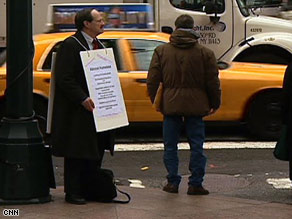
One person who has not, is Paul Nawrocki, who's taken to standing in the streets looking for work.
Paul Nawrocki says he's beyond the point where he cares about humiliation. That's why he weekly takes a 90-minute train ride to New York, where he walks the streets wearing a sandwich board that advertises his plight: The former toy-industry executive needs a job.

"Almost homeless," reads the sign. "Looking for employment. Very experienced operations and administration manager."

Wearing a suit and tie under the sign, Nawrocki -- who was in the toy industry 36 years before being laid off in February -- stands on Manhattan corners for hours, hoping to pass resumes to interested passers-by.

"When you're out of work and you face having nothing -- I mean, having no income -- pride doesn't mean anything," Nawrocki said. "You need to find work. I have to take care of my family."
This is just another example of the results of eight years of failed economic policies by the Bush Presidency and the Republican controlled Congress.

Republicans may excel at telling lies and using Rove Style politics to get elected, but it's pretty clear that they fail at governing. It's been demonstrated that both the Stock market and the economy performs much better under a Democratic President, as opposed to a Republican President.
President Bush's multitrillion-dollar tax cuts, which were strongly tilted toward the rich, could not prevent (and may even have contributed to) significant job losses. On the other hand, when Bill Clinton raised taxes on affluent people to balance the federal budget (while significantly expanding the Earned Income Tax Credit for working poor people), unemployment declined substantially. Under Clinton's watch, 22 million jobs were created.

Prefer a broader historical comparison? In the past three decades, since the Organization of the Petroleum Exporting Countries oil price shocks of the mid-1970s and the Republican turn toward "supply side" economics, the average unemployment rate under Republican presidents has been 6.7 percent – substantially higher than the 5.5 percent average under Democratic presidents. (The official unemployment rate takes no account of people who have given up looking for work or taken substantial pay cuts to stay in the labor force.) Over an even broader time period, since the late 1940s, unemployment has averaged 4.8 percent under Democratic presidents but 6.3 percent – almost one-third higher – under Republican presidents.

Lower unemployment under Democratic presidents has contributed substantially to the real incomes of middle-class and working poor families. Job losses hurt everyone – not just those without work. In fact, every percentage point of unemployment has the effect of reducing middle-class income growth by about $300 per family per year. And the effects are long term, unlike the temporary boost in income from a stimulus check. Compounded over an eight-year period, a persistent one-point difference in unemployment is worth about $10,000 to a middle-class family. The dollar values are smaller for working poor families, but in relative terms their incomes are even more sensitive to unemployment. In contrast, income growth for affluent people is much more sensitive to inflation, which has been a perennial target of Republican economic policies.
Obama's inauguration can't come fast enough.
Sphere: Related Content

Sunday, November 16, 2008

In Defense of Lawrence Summers

Recently, NOW has made some noises about not wanting Larry Summers as a candidate for Secretary of Treasury. I feel that he is being unfairly maligned for being a misogynist for some comments he made, while as President of Harvard University. Just as the rightwing idiots who took a comment that Gore made, out of context and ran with it, saying "Gore invented the internet" is false; so is the story about Larry Summers being against women or saying women are not as intelligent in Math and Science.

In 2005, Larry Summers was asked to speak and address the question about how they can diversify the workforce in Science and Engineering, and more specifically about increasing the number of women. You can read his entire speech here, and judge for yourself. However, this is what really was said, and how what Summers said was taken out of context.
There are many aspects of the problems you're discussing and it seems to me they're all very important from a national point of view. I'm going to confine myself to addressing one portion of the problem, or of the challenge we're discussing, which is the issue of women's representation in tenured positions in science and engineering at top universities and research institutions, not because that's necessarily the most important problem or the most interesting problem, but because it's the only one of these problems that I've made an effort to think in a very serious way about.
Essentially he was saying that there are three main proposals for why we don't have many women in the upper echelons:
...The first is what I call the high-powered job hypothesis. The second is what I would call different availability of aptitude at the high end, and the third is what I would call different socialization and patterns of discrimination in a search.
Summer's first reason, the high powered job hypothesis, speaks to a very real problem that we face in our society today. We all know it, not just women, but men. How do we push forward with having a successful career and having a family? It takes A LOT of work and focus to move up, whether in industry or in academia. Quite frankly, I know many people where their career couldn't have succeeded without the support of their spouse. Moreover, for women the burden becomes especially harder, because we need to make choices. If we have a family, then the father has to take just as a great a role in the share of raising the family, or in some cases, be the stay at home dad.

As a single 38 year old female, I'm single for a reason - my career. I put in long hours, and I made that choice a long time ago. In my profession, women in senior leadership positions either do not have children or if they do, their husbands are the ones who have flexible careers and follow their wives from location to location. While the cultural views of stay at home dads, and gender roles in marriages are changing, historically, we have been a society that expected the men to be the providers.

Summers recognized this social environment. He wasn't supporting it, nor was he saying that it was right, but that it was the current reality.

I think it is hard-and again, I am speaking completely descriptively and non-normatively-to say that there are many professions and many activities, and the most prestigious activities in our society expect of people who are going to rise to leadership positions in their forties near total commitments to their work. They expect a large number of hours in the office, they expect a flexibility of schedules to respond to contingency, they expect a continuity of effort through the life cycle, and they expect-and this is harder to measure-but they expect that the mind is always working on the problems that are in the job, even when the job is not taking place. And it is a fact about our society that that is a level of commitment that a much higher fraction of married men have been historically prepared to make than of married women. That's not a judgment about how it should be, not a judgment about what they should expect. But it seems to me that it is very hard to look at the data and escape the conclusion that that expectation is meeting with the choices that people make and is contributing substantially to the outcomes that we observe.
His second remark regarding the difference in aptitude on the high end, was what put him in hot water, and quite frankly was misunderstood. His remarks were looking at the variability (standard deviation) between Men and Women. He was NOT making an inference between the average intelligence of men and women. He was stating that the intelligence of men was probably MORE variable than women.

Here is what he said:
If one supposes, as I think is reasonable, that if one is talking about physicists at a top twenty-five research university, one is not talking about people who are two standard deviations above the mean. And perhaps it's not even talking about somebody who is three standard deviations above the mean. But it's talking about people who are three and a half, four standard deviations above the mean in the one in 5,000, one in 10,000 class. Even small differences in the standard deviation will translate into very large differences in the available pool substantially out. I did a very crude calculation, which I'm sure was wrong and certainly was unsubtle, twenty different ways. I looked at the Xie and Shauman paper-looked at the book, rather-looked at the evidence on the sex ratios in the top 5% of twelfth graders. If you look at those-they're all over the map, depends on which test, whether it's math, or science, and so forth-but 50% women, one woman for every two men, would be a high-end estimate from their estimates. From that, you can back out a difference in the implied standard deviations that works out to be about 20%.
Essentially from his methodology, he is ASSUMING that there is no IMPLIED difference in average intelligence between men and women. Summers made a deduction on the standard deviation of the upper tail to figure out what the variation would be to account for this difference between the number of men and women.

His ONLY POINT that he was trying to make is that men have a 20% greater variability than women. Actually if you think about it, what Summers is saying is that women could be more consistently smart, because their standard deviation is less. While with men, they can either be really smart, or really stupid.

Finally with regards to his third reason, on discrimination:
The most controversial in a way, question, and the most difficult question to judge, is what is the role of discrimination? To what extent is there overt discrimination? Surely there is some. Much more tellingly, to what extent are there pervasive patterns of passive discrimination and stereotyping in which people like to choose people like themselves, and the people in the previous group are disproportionately white male, and so they choose people who are like themselves, who are disproportionately white male. No one who's been in a university department or who has been involved in personnel processes can deny that this kind of taste does go on, and it is something that happens, and it is something that absolutely, vigorously needs to be combated.
He wraps up with this:
So my best guess, to provoke you, of what's behind all of this is that the largest phenomenon, by far, is the general clash between people's legitimate family desires and employers' current desire for high power and high intensity, that in the special case of science and engineering, there are issues of intrinsic aptitude, and particularly of the variability of aptitude, and that those considerations are reinforced by what are in fact lesser factors involving socialization and continuing discrimination. I would like nothing better than to be proved wrong, because I would like nothing better than for these problems to be addressable simply by everybody understanding what they are, and working very hard to address them.
So that's how Larry Summers finally got pushed out of Harvard, because his comment about the "variability of aptitude" was misinterpreted and misunderstood by a math illiterates. Granted, his abrasive personality, and other management controversies as a University President also contributed to his resignation, but surprisingly when polled, a majority of Harvard Students did not see the need for his resignation.

Larry Summers is quite frankly the most brilliant mind that we have in our country today, and sometimes with geniuses, their social IQ isn't what it should be. He is known to be abrasive, and yes he can make occasional gaffes. How many of us haven't made a dumb comment in the past?

Quite frankly, we are in the biggest economic crisis since the Great Depression, and we need to have the best mind on the job. Moreover, it is women who are hit the hardest during economic downturns, so I find it slightly ironic that feminists feel the need to go against the best interests of women, simply because of a remark that was taken out of context.

Now for those who have a beef with Larry, because he was for de-regulation. That's a different issue, and something that is more substantive and worthy to beat him over the head with.

However, one least defense on his part, he has seen the error of his ways, and in fact he is a big proponent of what's fundamentally wrong with this economy - which is Income Inequality.
According to former Clinton Treasury Secretary Larry Summers, the shift of income inequality over the last quarter century simply dwarfs the amount of money being discussed in partisan debates over wealth redistribution -- and represents a serious crisis of legitimacy for society.

In the last 29 years, Summers said, "you'll find that the share of income going from 80 to 99th percentiles has stayed the same. And those in top one percent have gained about $600 billion. Those in bottom 80 percent have lost about $600 billion."

Summers then calculated that this overall transfer of wealth averaged out to an additional $500,000 per year in earnings for those in the top one percent, and an $8,000 loss every year for those in the bottom 80 percent.

"If the bottom 80 percent had kept pace and earned that $8,000 ... their income growth would have been twice as high over the last generation as what we in fact observed. Think about this number: $600 billion a year. It is immense compared to any discussion of changing the tax system here or there," Summers added.
Some final thoughts, Slate.com gave their two cents on Obama surrounding himself by nerds:
Here's a radical suggestion: Barack Obama should pick the smartest people he can find for his Cabinet...But it makes sense for Obama to give greater weight to intellectual acumen and subject-specific knowledge than his recent predecessors have, both because of the depth of the problems he faces and because of his own style as a thinker and a decision-maker. Bush, whose ego was threatened by any outburst of excellence in his vicinity, politicized all policymaking and centralized it in the White House. Obama, happily, has the opposite tendencies. He is intellectually confident, enjoys engaging with ideas, and inclines to pragmatism rather than partisanship.

Another interesting article from SLATE.COM about Larry Summers:
Summers rose despite himself. He had energy and brains (and humor) but also a nasty arrogance. He was impatient with those less intelligent than himself (that is, everyone), lecturing members of Congress who asked stupid questions, berating foreign finance ministers for their foolishness, sneering at colleagues, undermining rivals, and generally abusing his staff. Summers had a poisonous reputation on Capitol Hill and an unsteady status in the White House—protected by his brilliance and by Rubin, but distrusted.

Summers—too smart and ambitious not to recognize his problem—approached it with the same exacting logic he brings to everything. He realized that he was in danger of being permanently tattooed as a jerk and perhaps blackballed from higher office. So, as Clinton's second term began, he set about domesticating himself. Says one longtime Summers staffer: "He had a huge incentive, because he could see that he couldn't get far in Washington rubbing people the wrong way. He realized this was a chunk of stuff he needed to learn. So he did it. It was like learning French for him."

Summers tried to imitate some of Rubin's gentility. He began repeating self-deprecating Rubinisms: "It's just one man's opinion, but …," and "I may be wrong but …" He taught himself to endure congressional idiocy and journalistic doltism with a smile. He remained as intense and hard-working as ever but eased up on berating his staff...He is zealous about global inequality. As a political economist, he lobbied incessantly for small steps that could have outsize benefits: educating girls, developing vaccines against diseases of poor countries, and forgiving Third World debt.
Sphere: Related Content

Saturday, November 15, 2008

The Obamas on 60 Minutes

This 60 Minutes interview, set to air tomorrow night, will their first interview since the election.


Watching this clip, I can't help but think "how cute is this couple!"

Here's the transcript:
"When did it sink in?" Kroft asked Michelle Obama.

"I'm not sure if it has really has sunk in, but -- I, I remember, we were watching the returns and on one of the stations Barack's picture came up and it said, 'President-elect Barack Obama,' Michelle Obama responded. "And I looked at him and I said, "You are the 44th president of the United States of America. Wow. What a country we live in.' "

"How about that?" the president-elect chimed in.

"Yeah," the future first lady agreed.

"Yeah," said the future 44th president. "Then she said, 'So are you going to take the girls to school in the morning?' "

"I did not!" protested Michelle Obama, laughing. "I didn't say that."

"It wasn't at that moment," quipped her husband.
Sphere: Related Content

Friday, November 14, 2008

Books for Oprah's Book Club ?

Today was a day for book deals, as news came out that Nate Silver, the baseball Statistician and pollster extraordinaire, has received a deal for two books:
... one about the art of prediction and the other a Freakonomics-style guide to the mechanics of electoral politics. Mr. Silver's agent, Sydelle Kramer of the Susan Rabiner Agency, told publishers she wanted indications of interest by Tuesday, but evidently the indications came faster than expected (so much for the art of prediction) and Ms. Kramer decided to just hold an auction today. According to several sources, that auction has ended, and Penguin Group USA has prevailed. Which of Penguin's imprint will publish Mr. Silver has not yet been determined, however, as there are at least three within the company that are jockeying for the privilege. The pricetag, we hear, is above $600,000 but below $1 million—a healthy sum even though it's paying for two books rather than just one. Update, 5:00 p.m.: New intelligence says Mr. Silver's advance is in the neighborhood of $700,000, give or take a few grand.
On the other end of the spectrum, we have Joe The Plumber, who is apparently going to have his own book (co-written by a real writer):
But charity isn't Wurzelbacher's sole goal. Sharing the wealth also means helping himself. To that end, he's working with writer Tom Tabback on a book about American values.
"Everyone came at me to write a book. They had dollar signs in their eyes. '101 Things Joe the Plumber Knows' or some stupid s--- like that. Excuse me, I am sorry," he said. "You know I will get behind something solid, but I won't get behind fluff. I won't cash in, and when people do read the book they will figure out that I didn't cash in. At least I hope they figure that out."

The book, called "Joe the Plumber -- Fighting for the American Dream," is to be released by a group called PearlGate Publishing and other small publishing houses.

"I am not going to a conglomerate that way we actually can get the economy jump started. Like there is five publishing companies in Michigan. There's a couple down in Texas. They are small ones that can handle like 10 or 15,000 copies. I can go to a big one that could handle a million or two. But they don't need the help. They are already rich. So that's spreading the wealth to me," he said.
Having just come from a mini holiday in Las Vegas, I'm wondering what the odds are that Joe the Plumber's book ever actually get's published? I'm also curious what the market is for Joe's pearls of wisdom.

Myself, I am looking forward to reading Nate Silver's books, as his website fivethirtyeight.com gave a very interesting statistical analysis on the probabilities of the election, based on the state polls.

Another book got a lot of buzz today, this one has been out for sometime, and that's Doris Kearns Goodwin's "Team of Rivals". Kearns had written about Lincoln's Cabinet:
Lincoln's political genius in this highly original work, as the one-term congressman and prairie lawyer rises from obscurity to prevail over three gifted rivals of national reputation to become president.
Goodwin described the effectiveness of Lincoln's approach:
Sorely underestimated as both an effective orator and leader, Abraham Lincoln surprised both his colleagues and critics as he rose to political prominence. But what's even more surprising was his ability to surround himself with a coalition of supporters made up almost entirely of men who had been both his political enemies and enemies of each other. Lincoln carefully navigated this "team of rivals" to achieve not only political success, but also victory in the Civil War. Could Obama be taking a page out of Lincoln's playbook??
This all came on the rumors of potential candidates for Secretary of State. Both Governor Bill Richardson and Senator Hillary Clinton have traveled to Chicago to meet with President-Elect Obama, officials on both sides have leaked word that they are strong contenders to be appointed SoS.
WASHINGTON (AP) - President-elect Barack Obama is considering primary election rivals Hillary Rodham Clinton and Bill Richardson to be his secretary of state, according to Democratic officials who revealed his secret meetings with both as he weighed the decision on folding former foes into his new administration.
News also came out that John McCain is set to meet with President Elect Obama on Monday - oh to be a fly on the wall of that meeting!
Sphere: Related Content

Thursday, November 6, 2008

Obama's Presidency

Now that the election is over, the media's attention and frenzy for news turns to Obama's Presidency, his agenda, and most importantly Cabinet picks! Already rumors that Rahm Emanuel would be Obama's Chief of Staff were confirmed when he formally announced his acceptance for this tremendous position of responsibility.

What's interesting is that already we see a hint of how Obama would govern as President of the United States from his quick actions post Election Day.

He has campaigned on transparency and public involvement in the government process. In this regard, Obama is providing a way to get the American public to get engaged in their own government with the Change Government Website.

Moreover, it appears that the tradition of giving plum Ambassadorships to large donors is a thing of the past.
There is major agita among some key elements of President-elect Barack Obama's juggernaut. For example, the big-money types and "bundlers," the fundraisers who helped put together Obama's stunning financial advantage, are expecting their reward -- say a nice, cushy ambassadorship in Rome or Paris or London. (By tradition, about one-third of the nation's 190 ambassadors are political appointees. They're the ones who get the fine European postings.)

But the chatter is that they'd better not count on it. The traditional sale of most ambassadorships, so aptly carried on during the Bush administration, may not continue. Early speculation is that Obama may be more inclined to follow the Clinton model and select people, often political types, with some foreign policy credentials or knowledge of a country's language or culture.
Rahm Emanuel's selection as Obama's Chief of Staff again shows the judgment that Obama exercises by selecting a capable, savvy, experienced, and loyal partner to be a part of his team. Rahm (aka "Rahm-bo") has a reputation for toughness and for getting things done. This sends a clear signal that Obama is focused on delivering results. Clearly this has the GOP scared, and fearful of the demonstrable results that Obama will be able to deliver with a Chief of Staff like Rahm Emanuel.

Already, some of the GOP were trying to pain Emanuel as partisan and a "bad choice" on the part of Obama. Rep. Boehner (R-OH) demonstrated how petty and childish the GOP plans to be going forward by releasing the statement.
“This is an ironic choice for a president-elect who has promised to change Washington, make politics more civil and govern from the center.”
The RNC was quick to put out a statement that was made no bones to hide their unhappiness upon hearing the news:
“Barack Obama’s first decision as President-elect undermines his promise to ‘heal the divides,'" said RNC spokesman Alex Conant. "Rahm Emanuel is a partisan insider who played a lead role in breaking Washington. The White House needs a chief of staff – not a chief campaigner like Emanuel. Our nation will be ill-served if Obama runs the White House the way ‘Rahmbo’ ran the Democratic Congress.”
Interestingly, the Washington Post, also observed the same thing, and gave it's advice, although I am doubtful that Boehner and company have any rational sensibilities left.
The less-than-gracious GOP statements, and the turmoil in the House leadership ranks, underscore the choice ahead for the Republican minority: whether to try to cooperate with the new president or, with moderates an endangered species in the party, to form an unyielding opposition. We are not in the business of giving either party advice on how to tend to its electoral interests, but the public does not seem positively inclined toward political jockeying and reflexive obstructionism. Republicans should, of course, stand up for their principles, although the party, in the aftermath of its loss, will inevitably spend some time debating exactly what those are. But the country -- and, we suspect, the party as well -- would benefit from a sincere effort to find common ground with the new administration on some of the daunting issues facing the country in the months ahead.
The response from Lindsey Graham gives an inkling of the growing divide in the Republican party between cultural warriors such as Boehner, and more traditional or moderate conservatives within the Senate.
"This is a wise choice by President-elect Obama. Rahm knows Capitol Hill and has great political skills. He can be a tough partisan but also understands the need to work together. He is well-suited for the position of White House Chief of Staff.

I worked closely with him during the presidential debate negotiations which were completed in record time. When we hit a rough spot, he always looked for a path forward. I consider Rahm to be a friend and colleague. He's tough but fair. Honest, direct, and candid. These qualities will serve President-elect Obama well."
Some Democrats have concerns whether Emanuel is an appropriate choice given that he served as part of Clinton's White House Staff. This is where I think Democrats need to be careful in not making the same mistake as Bush and Cheney did when they entered the White House. Bush and Cheney were practically religious zealots about removing people from government positions if they were in any way associated with Democrats or the Clintons. It wasn't about experience or knowledge, it was about ideology. Hence, the illegal firings in the justice department, and the litmus tests they imposed on party loyalty.

This kind of slash and burn style brings problems because you risk losing qualified individuals with talent. For example in the business world, a successful merger of two organizations takes into consideration the top talent and best practices between the two companies, in order to create something greater than the sum of the two parts. Any company that ignores or denies the value that the other company can bring to the table, does so at their own peril.

Let's be clear, what makes Obama so refreshing, and what he means by Change is "Pragmatism". Forget any of the other terms, liberal, socialist, centrist, etc. Obama is first and foremost pragmatic.

He's about what works and what doesn't. Don't expect Obama to be prejudiced against anyone because of who they worked for or which party they belong to. It's clear that for Obama, it's about who is going to be effective, add value, display judgment, knowledge, and experience. This is the BIG change. It's about what you know, and how you will contribute to making a difference.

Change means saying no to governance based on ideology
Change means valuing experience, valuing collaborative approaches, and knowledge
Change means taking the best practice approach

This means that Obama will be looking back at history and taking the best approach for what works.

Ideology has no place in governance, and Obama provided us a glimpse of his pragmatic nature when asked of his philosophy for selecting Justices for the Supreme Court. In an interview with Brian Williams, Obama made it clear that "Roe v. Wade" was not a litmus test for him, that it was more about past experiences, judgment, and their philosophy with regards to the US Constitution.
WILLIAMS: Senator, a question about the Supreme Court. Everyone running for President always says, especially on the narrow issue of abortion rights -- no litmus test. It's said on both sides of the issue. And if that's true, if you're not going to call a future Justice into the Oval Office, if you're successful in this endeavor and bring up the subject, how then do you also avoid surprises? I don't think George H.W. Bush, 41, ever dreamed that in Justice Souter he was appointed a dependable liberal vote.

OBAMA: Right.

BRIAN WILLIAMS: And as -- Eisenhower for years called Justice Brennan, his biggest mistake in office. Two surprises that just come to mind.

OBAMA: Right. Well, look, I think that you -- what you can ask a judge is about their judicial philosophy. And as somebody who taught constitutional law for ten years, who actually knows a lot of the potential candidates for Supreme Court on the right as well as on the left 'cause I've taught with them or interacted with them in some way -- I can tell you that how a Justice approaches their job, how they describe the path of interpreting the Constitution, I think can tell you a lot.

And so my criteria, for example, would be -- if a Justice tells me that they only believe the strict letter of the Constitution -- that means that they possibly don't mean -- believe in -- a right to privacy that may not be perfectly enumerated in the Constitution but, you know, that I think is there.

I mean, the right to marry who you please isn't in the Constitution. But I think all of us assume that if a state decided to pass a law saying, 'Brian, you can't marry the woman you love,' that you'd think that was unconstitutional. Well, where does that come from? I think it comes from a right to privacy. That may not be listed in the Constitution but is implied by the structure of the Constitution.
Sphere: Related Content

Tuesday, November 4, 2008

BARACK OBAMA WINS THE ELECTION!


It's official - Barack Obama is the 44th President of the United States


------
Titans Spirit (Score) - Trevor Rabin
Sphere: Related Content

I Voted Today !

I voted today, and participated in our democratic process, unique to our country. This is a right that every American has that protected by the constitution, and for which many have fought for.

I voted for Change and for a brighter future for America

I voted for Restoring Honor and rejecting Torture

I voted for Fairness and finally saying no more to failed Trickle Down Economics

I voted for Veterans and our Servicemen around the world

I voted for Respect and to say no more to Divisive Politics

I voted for Equality for ALL AMERICANS and not just a select few

I voted for ending American Hegemony and rejoining the International Community

......I voted for Barack Obama.

We need to make sure our democracy stays vibrant, stays law abiding and respectful.To a certain extent we are a beacon of democracy for the world. As much as the Constitution has done for us, the American democratic example can do for the world.
Sphere: Related Content

Monday, November 3, 2008

Election Eve Sadness and Hope

There was news today that Barack Obama's grandmother, Madelyn Dunham, has passed away.
It almost seems too bittersweet that she would pass away before Election Day.


Madelyn Dunham:October 26, 1922 - November 3, 2008
She and her late husband Stanley raised the young Barack in Hawaii for many years while his mother, who had remarried, lived abroad.

Known within the family as "Toot", a shortened form of the Hawaiian word "tutu" meaning grandmother, she gave him a stable home and the traditional American values brought from her own Midwestern childhood. She was also a trailblazer in her own right, having risen from a lowly position to be one of the first women vice-presidents of the Bank of Hawaii.

In a major speech on race he gave in March, Mr Obama described her as "a woman who helped raise me, a woman who sacrificed again and again for me, a woman who loves me as much as she loves anything in this world".
When my own father passed away, it was a shock and yet not completely a surprise, as he had been diagnosed with cancer. After a hard battle, the cancer became too much, and spread too far and too quickly. We knew we didn't have a lot of time left, but I knew that still his thoughts were for us. That is always the way with parents and grandparents, they think more about the happiness and well being of their children. I can only imagine how much pride Obama's grandmother must have had for his accomplishments.

If Barack Obama becomes the 44th President of the United States, it will mean so much to so many Americans, including myself, but in particular to many older Americans who experienced the Civil Rights movement.

This picture of this older gentleman in Times Square watching Obama's acceptance speech in Denver during the Democratic National Convention says it all.
The tears and naked emotion on this man's face would move anyone with a heart. So many African Americans never thought that they would see this day in their lifetime.

Tomorrow I will cast my vote for Barack Obama, and hope that America finds the strength and the common sense to vote for Obama, our best hope for the next President who could lead the US into a new chapter in history.
Sphere: Related Content