Showing posts with label US Economy. Show all posts

Sunday, January 11, 2009

Why won't "Trickle Down" Economics Die?

I was watching "Meet the Press" this morning, and the first topic of the show was, of course, about the economy and Obama's stimulus package. David Gregory had a round table discussion with former Congressman David Bonior of Michigan; editorial page editor of The Wall Street Journal, Paul Gigot; chief Washington correspondent for CNBC and New York Times political writer John Harwood; Vanity Fair contributing editor Bethany McLean; and chief economist of Moody's economy.com Mark Zandi.

It was clear that Obama is already on the offensive, marketing his plan, and getting the public acclimated to this stimulus plan. The show didn't offer anything new in terms of analysis. The entire discussion can be summed up as follows:

1. We need to do this, otherwise the economy will be in bigger trouble
2. We need to do something, but we should do something else, like tax cuts
3. How will we pay for this ~ followed by requisite ringing of hands

MR. GREGORY: And what about--Paul, what about the idea of tax cuts as being as stimulative as infrastructure spending?
MR. GIGOT: Well, I think they're much more stimulative if they're the right tax cuts.
MR. GREGORY: Mm-hmm.
MR. GIGOT: I mean, we have a capital strike going on right now. Nobody wants to take any risks, nobody wants to make any investments. Part of it's the uncertainty about the damage that Congress might do, but part of it is also the fact that everybody's frozen. You need the incentives to invest, particularly in the private sector.
MR. GREGORY: Right.
MR. GIGOT: I think a, a tax cut, a big corporate rate tax cut, for example, or an across the board tax cut would be a lot more stimulative than this public spending, which has to come from somewhere.

At what point will Conservatives wake up and smell the coffee - "Trickle Down" Economics is DEAD. The last 20 years of deficit spending and tax cuts under Republican Presidents do nothing but hamper the Government's ability to intervene in Economic downturns, and in fact do more to harm to the economy, causing false bubbles, uncontrollable greed, and recessions.

There continues to be this debate on what spurs the economy. It's a basic fundamental principle that the economy grows as a result of consumption and spending. Capital investments facilitate growth, but capital investments are worthless, if there is no growth or profit to be had.

We need to recognize that the key to growing the economy, is growing DEMAND. Demand for goods and services will continue to exist and grow, as long as people have real income keeping pace. Once Income falls or declines, so does the DEMAND, hence production also slows, continuing a spiral contracting of the economy.

So I don't care how much of a tax cut incentive the government gives, unless there is demand and organic market growth potential for the business, there won't be a need for that capital.

Tax cuts have one small benefit, in that they provide instant relief, and add income for consumption. However, most economists recognize that the dollar return on investments for tax cuts are less than the cost of the tax cuts themselves. It's also clear that Obama will need some tax cuts, to gain Republican support for his plan.

MR. GREGORY: Mark Zandi, as an economist, what's your big question about it?
MR. MARK ZANDI: Is it big enough? Is $750 billion, a trillion dollars enough? The economy is in great trouble. We lost 500,000 jobs in December, 2.6 million jobs in 2008. That's the most since 1945.
MR. GREGORY: Mm-hmm.
MR. ZANDI: Unemployment's 7.2 percent. So is 750 billion, a trillion going to be enough to jump-start the economy, to get the private sector back in the game?

MR. GREGORY: The issue of impact, Mark Zandi, speaks to some of the risk of how long it takes. This is how The New York Times reported it Saturday: "The risk is that Obama and the Congress will weigh down their effort with measures that cost many billions of dollars but may not have much impact on economic activity. Tax breaks, for example, usually produce less than $1" worth "of stimulus for every dollar they cost, economists say. Spending on public construction projects, like highways and bridges, produces the most economic activity--but there's a limit to how many projects are `shovel-ready,' and even those take time to generate jobs and ripple through the economy."

MR. ZANDI: But we, but we have no choice. We really don't. I mean, if we don't do something like this, a stimulus package, a foreclosure mitigation plan, the economy is going to slide away. Unemployment is going to rise into the double digits and we're going to lose tax revenues as a result and the deficit's going to be even larger than otherwise.
MR. GIGOT: But, Mark, don't you think that monetary policy is very powerful here? I mean, Christina Romer, who's the president's economic adviser now, she has written in 1994 that fiscal actions have relatively small effects. The big bang for the buck is monetary policy.
MR. ZANDI: In normal times I would agree with you, Paul, but this--the link between the Fed and the economy runs through the financial system. The financial system is literally broken. There--if--you can provide as much cash as you want; but you don't get credit, you don't get it done.

MR. GIGOT: I mean, if you're borrowing it for aircraft carriers like Reagan did to win the Cold War, you get a big payoff down the road. If you're doing it for tax cuts that really stimulate and drive private investment, and in two or three years' time bring the economy back, great. But if it goes to pork, if it goes to green jobs that may sound good in the short term but may not have a market response or a market for them, then it's a waste.


What still gets me is the ridiculous Republican Talking points that Paul Gigot continues to expound, that Monetary Policy is the answer, and that Tax Cuts (to the wealthy and Corporations) are more effective than any fiscal policy. The real gem was the Paul's glowing and inaccurate description of the benefits of Reagonomics. The fact that the WSJ editorial board seems to only regurgitate Republican ideas and principles, renders the paper virtually worthless, except as a birdcage liner.

Overall, my opinion is that I think Obama has shown his political savviness, in the fact that he already recognizes that most economists believe that the stimulus plan will have to be much bigger, hence it's much easier to start with something smaller and let it grow, as opposed to put something too big on the table that will have Republicans balking. What's ironic, is that after 8 years of deficit spending under a Republican President and a Republican controlled Congress, we suddenly have Republicans growing a conscious about the size of the deficit.
Sphere: Related Content

Thursday, January 8, 2009

Who will buy US Debt?

Today, Obama announced his economic Stimulus plan "American Recovery and Reinvestment," the name of his proposed $750 billion stimulus package at George Mason University.
"Throughout America’s history, there have been some years that simply rolled into the next without much notice or fanfare. Then there are the years that come along once in a generation – the kind that mark a clean break from a troubled past, and set a new course for our nation. This is one of those years. We start 2009 in the midst of a crisis unlike any we have seen in our lifetime – a crisis that has only deepened over the last few weeks. Nearly two million jobs have now been lost, and on Friday we are likely to learn that we lost more jobs last year than at any time since World War II. Just in the past year, another 2.8 million Americans who want and need full-time work have had to settle for part-time jobs. Manufacturing has hit a twenty-eight year low. Many businesses cannot borrow or make payroll. Many families cannot pay their bills or their mortgage. Many workers are watching their life savings disappear. And many, many Americans are both anxious and uncertain of what the future will hold.

I don’t believe it’s too late to change course, but it will be if we don’t take dramatic action as soon as possible. If nothing is done, this recession could linger for years. The unemployment rate could reach double digits. Our economy could fall $1 trillion short of its full capacity, which translates into more than $12,000 in lost income for a family of four. We could lose a generation of potential and promise, as more young Americans are forced to forgo dreams of college or the chance to train for the jobs of the future. And our nation could lose the competitive edge that has served as a foundation for our strength and standing in the world. In short, a bad situation could become dramatically worse...."

What's interesting is that earlier this week, the International Herald Tribune reported that China is losing it's taste for US Debt.
China has bought more than $1 trillion in American debt, but as the global downturn has intensified, Beijing is starting to keep more of its money at home - a shift that could pose some challenges to the U.S. government in the near future but eventually may even produce salutary effects on the world economy.

But now, Beijing is seeking to pay for its own $600 billion economic stimulus - just as tax revenue falls sharply as the Chinese economy slows. Regulators have ordered banks to lend more money to small and midsize enterprises, many of which are struggling with slower exports, and Chinese bankers say they are being instructed to lend more to local governments to allow them to build new roads and other projects as part of the stimulus program.

Given the ambitious stimulus plan that Obama has in mind, it will be interesting to see how the Treasury will raise the capital, with demand decreasing for US Debt. In addition, what will be the effect of rising interest rates on capital investments for the private sector and for consumers?
Sphere: Related Content

Saturday, December 13, 2008

Senate Republicans want a Depression

I continue to be amazed at the idiocy of Senate Republicans. How eager they are to stand on principle and bloviate in front of reporters and television on why they couldn't in consciousness vote for the Auto Bailout.

First we need to recognize that we are NOT talking about a bailout. What we are talking about is a LOAN of significant amount to the Auto Industry, not just free money. This has already been done in 1980 when the US Government provided a loan to Chrysler, which enabled Lee Ioccoca to turn Chrysler around with the introduction of the K Car and the mini-van. With the revival of Chrysler, and the investments made, they were able to repay the loan back to the US Government with interest.

Secondly, while there are many problems within the Auto Industry brought about by poor decision making, lack of vision and strategy, and poor brand management, we need to recognize that part of the sudden downfall of the Big 3 has been due to the poor economic environment and market forces that created a perfect storm in an industry unable to react quickly.

The idea that the Auto Industry can react to market forces with lightening speed is ridiculous. We are talking about a heavy manufacturing industry that produces durable goods, you can not change production lines and factories with a switch of a lever. Moreover, what's even more idiotic is the idea that the auto industry can operate as a bankrupt company with restructuring as many opponents to the bailout loan are suggesting. Unlike the Airline Industry, the auto industry produces a durable good that most consumers keep for on average 7 to 10 years. An Airline ticket is a cheap service that is quickly consumed on a single use. Studies have been conducted, and it is clear that consumers will NOT take the risk to purchase a vehicle from a company that has been bankrupt.

While it's recognized that many changes need to come about in terms of the strategy, brand management, and operations within the Auto Industry, it's also clear that in order to bring these changes about, the Big 3 need capital to restructure.

What the Senate Republicans did by failing to provide the Big 3 with this loan is light a match that could implode the American Economy, resulting in the next Depression, because of their irrational dislike of Unions.

The idea that it is Unions that are at the heart of the problems of the auto industry and failure for resolution on the bailout loan is completely ludicrous. The only ones to blame are the peopel who voted against it - pure and simple. The UAW had made significant concessions; understanding that their whole future and industry was at stake. Furthermore, this constant lie being reported by the media and Congress on the idea of the $70/hour wage that American Union Autoworkers make is so blatantly false and irresponsible.

The Union Auto Workers do NOT make that much per hour, otherwise we would certainly be seeing a much better economy! Union Auto makers make on average $28/hour. The $70/hour that continues to be falsely bandied about is a COST to the company NOT THE WAGE! What the Auto Industry has done is totaled the entire COST wages + benefits for all current workers, IN ADDITION to ALL retired workers, and divided by ONLY current workers. As a result, not only are we reporting a false number to the American Public, but the American public and the Media are too stupid to understand the difference between wage and cost. Wage being the take home pay, and the cost being a more expansive number to a company. If this is the new standard for reporting income, should we change the federal income tax code to reflect this new definition?

Furthermore, when will we stop demonizing unions? It is because of unions that we have safer work places, child labor laws, and equitable pay. Do unions also have their problems? Sure, but let's not forget the good that they also bring. I would argue just as fiercely that the myth that "unions are the reason for the downfall of business" is just as ridiculous a generalization as the myth that "big business is just out to screw the worker".

Let's be clear, if the auto industry fails, we are talking an impact of potentially up to 3 million jobs and a reduction of $150.7 BILLION dollars in Personal Income within one year. This is a significant impact to the economy. This will have a huge multiplier effect on consumption and demand for goods and services. Think of the impact of the loss in income on other durable goods such as homes, appliances, clothing, and electronics. Outside of direct personal income, the failure of the Auto Industry would also impact their suppliers and vendors, who would in turn see a contracting of their business.

You can expect a knock on effect not only on the retail and service industry, but the US Government! Expect the government deficit to grow even bigger due to more payouts on unemployment and health care costs for the uninsured, along with lower tax revenues. The cost to the US government and the economy will be MUCH bigger than the $34 Billion dollars for the Auto bailout loans that were originally suggested.

We simply can not let an entire industry to disappear overnight without a plan to modernize and transition to a new industry.

There is MORE at stake than just an auto worker and auto industry. Anyone who thinks that we should just let the market forces work and let them fail, are totally shortsighted in understanding the complete impact and devastation it would have on the American Economy as a whole.

If the Auto Industry dies and the US economy spirals out of control, let's be clear, while there will be plenty to go around for blame on the mismanagement of the auto industry, the final implosion can solely be laid at the feet of the moronic and irresponsible Senate Republicans who voted against this measure, simply to assuage their ideology.
Sphere: Related Content

Saturday, December 6, 2008

Sign of the times


Friday's jobless numbers reporting an additional loss of 533,000 jobs for the month of November continues to pummel the stock market, and brings great concern on the state of the economy. While the current unemployment rate is at 6.7%, the real unemployment rate is most likely much higher, as it does not take into consideration those who have simply given up looking for work.
The unemployment rate has been made less meaningful by the long-term rise in dropouts from the labor force. The simple percentage of people without jobs — including retirees, stay-at-home parents and discouraged would-be job seekers — can also be misleading, though. It has dropped in recent decades mainly because of the influx of women into the work force, not because the job market is fundamentally healthier than it used to be.

The Labor Department does publish an alternate measure of unemployment, which counts part-time workers who want full-time work, as well as anyone who has looked for work in the last year. (The official rate includes only people who told a government surveyor that they had looked in the last four weeks.)

This alternate measure rose to 12.5 percent in November. That is the highest level since the government began calculating the measure in 1994.

Perhaps the best historical measure of the job market, however, is the one set by the market itself: pay.

During the economic expansion that lasted from 2001 until December 2007, when the recession began, incomes for most households barely outpaced inflation. It was the weakest income growth in any expansion since World War II.
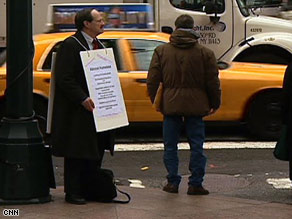
One person who has not, is Paul Nawrocki, who's taken to standing in the streets looking for work.
Paul Nawrocki says he's beyond the point where he cares about humiliation. That's why he weekly takes a 90-minute train ride to New York, where he walks the streets wearing a sandwich board that advertises his plight: The former toy-industry executive needs a job.

"Almost homeless," reads the sign. "Looking for employment. Very experienced operations and administration manager."

Wearing a suit and tie under the sign, Nawrocki -- who was in the toy industry 36 years before being laid off in February -- stands on Manhattan corners for hours, hoping to pass resumes to interested passers-by.

"When you're out of work and you face having nothing -- I mean, having no income -- pride doesn't mean anything," Nawrocki said. "You need to find work. I have to take care of my family."
This is just another example of the results of eight years of failed economic policies by the Bush Presidency and the Republican controlled Congress.

Republicans may excel at telling lies and using Rove Style politics to get elected, but it's pretty clear that they fail at governing. It's been demonstrated that both the Stock market and the economy performs much better under a Democratic President, as opposed to a Republican President.
President Bush's multitrillion-dollar tax cuts, which were strongly tilted toward the rich, could not prevent (and may even have contributed to) significant job losses. On the other hand, when Bill Clinton raised taxes on affluent people to balance the federal budget (while significantly expanding the Earned Income Tax Credit for working poor people), unemployment declined substantially. Under Clinton's watch, 22 million jobs were created.

Prefer a broader historical comparison? In the past three decades, since the Organization of the Petroleum Exporting Countries oil price shocks of the mid-1970s and the Republican turn toward "supply side" economics, the average unemployment rate under Republican presidents has been 6.7 percent – substantially higher than the 5.5 percent average under Democratic presidents. (The official unemployment rate takes no account of people who have given up looking for work or taken substantial pay cuts to stay in the labor force.) Over an even broader time period, since the late 1940s, unemployment has averaged 4.8 percent under Democratic presidents but 6.3 percent – almost one-third higher – under Republican presidents.

Lower unemployment under Democratic presidents has contributed substantially to the real incomes of middle-class and working poor families. Job losses hurt everyone – not just those without work. In fact, every percentage point of unemployment has the effect of reducing middle-class income growth by about $300 per family per year. And the effects are long term, unlike the temporary boost in income from a stimulus check. Compounded over an eight-year period, a persistent one-point difference in unemployment is worth about $10,000 to a middle-class family. The dollar values are smaller for working poor families, but in relative terms their incomes are even more sensitive to unemployment. In contrast, income growth for affluent people is much more sensitive to inflation, which has been a perennial target of Republican economic policies.
Obama's inauguration can't come fast enough.
Sphere: Related Content

Tuesday, September 9, 2008

Still think you are better off ?

This past weekend, we all saw the single largest bailout by the US Tax payers for the Mortgage companies Freddie Mac and Fannie Mae.

Contrary to Sarah Pahlin's mistaken understanding, neither of these are public institutions. They simply have the guarantee of the backing of the US Government. So while the executive leadership made disastrous decisions, and corporate lobbyists brainwashed the Republican Congress to avoid necessary regulation, the mortgage industry imploded.

This is essentially one of the largest and most expensive corporate welfare programs that have taken place under a Republican administration. This of course does not help our budget deficit.

Today the CBO has come out with a very bleak projection for the US Economic outlook.

http://money.cnn.com/2008/09/09/news/economy/cbo_budget_update/?postversion=2008090912


"The budget deficit will jump by $246 billion to $407 billion this year, the Congressional Budget Office estimates in a report released Tuesday."

"Over the long run, growing budget deficits and the resulting increases in federal debt would lead to slower economic growth," the agency said.

The budget deficit shot up 153% from last year's shortfall of $161 billion. The government's fiscal year ends Sept. 30. The agency attributes the jump to "a substantial increase in spending and a halt in the growth of tax revenues."


Now more than ever, the country needs to wake up and choose Obama to lead us out of this mess. We can not afford another Bush administration or worse - which is what McCain would offer!

It's clear based on economic history, Democratic Presidents are much better at managing the economy than Republican Presidents.

http://www.nytimes.com/2008/08/31/business/31view.html?em


This is NOT a difficult election.

Either we change the policy and leadership or we stick with MORE of the same.

Sphere: Related Content

Sunday, August 24, 2008

It's the Economy Stupid!

As I look at the state of our Economy, it’s incredible how much has changed in 8 years, and not for the better. This is not only my opinion, but the opinion of countless Americans. From the various polls that have been mentioned and discussed, we know that a majority of Americans believe the country is headed in the wrong direction. In fact, when it comes to the Economy, more Americans believe by a significant majority, that Obama is more qualified to tackle the issues on Economy, Taxes, Health, and Energy (Gas).

The economy is an important issue facing Americans today. It impacts them on a micro level – personally, in terms of their ability to literally have a home, to buy necessities, and save.


From the Wall St. Journal, we can see the declining trends in income, during the Clinton Administration, we saw a real (inflation adjusted) and steadily increasing rise in income. But in 6 years since Bush has taken office, we’ve seen a drop in income for median Middle Class Income.


And while Bush has lowered Taxes, the middle class has seen the value of their tax cuts being eaten away by inflation, represented in higher food and fuel prices. Furthermore, it’s visibly shocking to see the decline in National Savings Rate. So Americans are consuming, but using debt to drive consumption!

In addition, I had mentioned in an earlier posting, that the Tax Cuts that the Bush Administration has put in place, effectively benefited the top 1% of the earners more than the middle class.


To give you an idea of what that means, we look at the 2006 income distribution as referenced by US Census Bureau.

Median Income Ranges
1st Quintile $ 0 - $ 26,999
2nd Quintile $ 27,000 - $ 46,999
3rd Quintile $ 47,000 - $ 71,199
4th Quintile $ 71,200 - $109,150
5th Quintile > $109,151
Top 5% Income $191,060 – and higher

Essentially, 22% of the population, on average for 2006 incomes, make more than $191,000.

However, what’s striking to me is 51% of the population, in 2006, made less than $72,000, many having families. Given the rising costs of fuel, food, and housing, it is no wonder that many families continue to struggle. In addition, excluding the top 5% Income, we have, on average ,about 78% of the population making $191,060 or less.

When we talk about our personal economy, we can not ignore the impact of Taxes. Everyone dreads paying taxes, and it is a large factor driving disposable income. So let’s put it all on the table, once and for all. McCain continually puts out false information on who is hurt and benefits between the two candidates Tax Plans. What puzzles me is that Average Americans continue to be deluded that McCain is going to go to bat for them! He doesn't understand nor does he care about the middle class, otherwise his policies would reflect his priorities.

From the Washington Post (a conservative newspaper), they put in a nice chart to compare average impact of the two candidates’ tax policies. This is coming from the Tax Center Policy of the Brookings Institute. I have read the tax analysis, and have come up with slightly different numbers depending on the year 2009 vs 2012.

However, the Washington Post does give a fairly accurate comparison.


My one problem with Washington Post's chart, is that it does not further breakout the $603,403 to $2.87 million income bracket, because it gives a false impression that people making $603,403 an increase of $115,974 in taxes under Obama's plan. One has to keep in mind that it's an average, and that of course the incremental tax will be vary for those making $603,403 vs. $2.87 Million.

On a blanket statement, yes we can say McCain’s tax plan does in total give a higher tax cut than Obama. However, the devil is always in the detail, and if you look to see how much the Top 5% and top 1% Earners benefits vs. the middle class, it is very clear that Obama’s tax plan would benefit the majority of the population, more than McCain. McCain provides a disproportionate tax cut to an income bracket, to whom it has less an incremental impact, than to the middle class.

Paul Krugman noted economist, provides an layman’s perspective on the tax hoopla, and the McCain Lies regarding tax-cuts.

http://www.nytimes.com/2008/08/22/opinion/22krugman.html

Why do I care so much about the other people’s income? Simply put, without average American incomes being sufficient to purchase goods and everyday consumer items, I am out of a job. I work for a Large Consumer Packaged Goods Company, we place a lot of emphasis on brand, quality, and performance of our products, but our products are not on an infinite price elasticity curve. At some point, consumers will turn away, and buy cheaper knockoffs.

Henry Ford had it right; he is recognized with being the father of modernizing industrial assembly and production, as well as recognizing the benefits and efficiency of improving the quality of his employees, thereby reducing turnover and improving productivity. Although he can not be by any stretch of imagination labeled a socialist, as he opposed unions, he did however advocate “welfare capitalism”, and had a policy to pay his workers a wage, where they could also afford to buy the very items they produced.

There is a cycle in our capitalistic economy. Wages and Income are tied to consumption rates, and in turn, those consumption rates grow our GDP, and when our GDP and overall incomes rise, everyone benefits.

Obama understands this, this is why his focus is more on increasing Average American's disposable income, and truly growing the economy, rather than focusing on the deficit, which was what Bill Clinton did. Bill Clinton and Robert Rubin, felt that the key to the economy, was to get the deficit undercontrol, and they were right. However, we are in a period of both a recession and an inflation, and the primary focus is the get the economy back on track, and here Obama's Chicago Economics background comes very much in play.

McCain with his "I don't know much about Economics" mentality, has been poorly advised by his economic advisors. But with such people like Phil Gramm famous for castigating Americans as "whiners" and saying the recession is all in our heads, and who sits on the board of UBS, one of the major banks involved in the mortgage and securities investigation, I'm not surprised at McCain's cluelessness.

I’m not done on the subject of Taxes, but we need to also take a look at Macro issues, such as the Deficit!
Sphere: Related Content